The Complete Guide to English Vowel Sounds and IPA: Master Tense, Lax, and Diphthong Vowels
A comprehensive guide to the 20 English vowel sounds with IPA charts, acoustic formant frequencies (F1/F2), tongue positions, and practical minimal-pair drills.
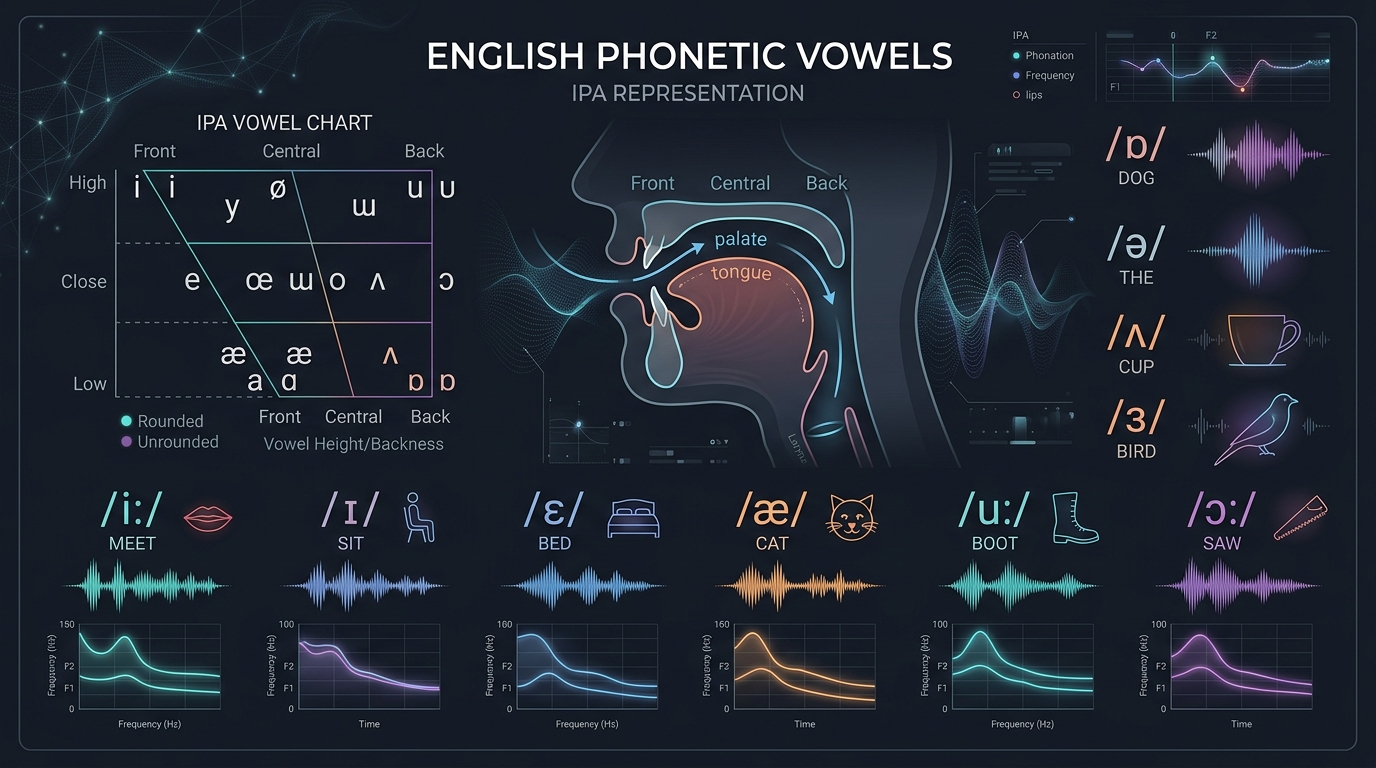
If you have ever felt that your English sounds slightly "off" despite using correct grammar and vocabulary, vowels are almost certainly the primary cause. In acoustic phonetics, vowels carry over 70% of an accent's perceived melody, timbre, and regional identity.
While English spelling uses only five vowel letters (A, E, I, O, U), standard English dialects possess up to 20 distinct vowel phonemes (including monophthongs and diphthongs).
In this comprehensive guide, we unpack the acoustic science of English vowels, the International Phonetic Alphabet (IPA) vowel quadrilateral, and practical drills to master every single sound.
1. The Anatomy of a Vowel: Tongue Height, Backness, and Lip Rounding
Unlike consonants—which involve an obstruction or constriction of the airflow by the lips, teeth, or tongue—vowels are produced with an open vocal tract.
Acoustic linguists classify all English vowels along three primary anatomical dimensions:
- Tongue Height (Vertical Axis): How close the tongue body comes to the roof of the mouth (High / Close, Mid, Low / Open).
- Tongue Backness (Horizontal Axis): Whether the highest point of the tongue is positioned toward the front, center, or back of the oral cavity (Front, Central, Back).
- Lip Rounding: Whether the lips are rounded (pursed, as in /uː/ boot) or unrounded/spread (as in /iː/ see).
The Acoustic Formant Blueprint (F1 vs. F2)
When an AI speech engine analyzes your recording, it calculates acoustic formants—resonant frequency peaks generated by the shape of your vocal tract:
| Vowel Sound (IPA) | Example Word | First Formant (F1 - Height) | Second Formant (F2 - Backness) | Lip State |
|---|---|---|---|---|
| /iː/ (FLEECE) | sheep, meet, see | ~280 Hz (Low F1 = High Tongue) | ~2250 Hz (High F2 = Front) | Spread / Unrounded |
| /ɪ/ (KIT) | ship, bit, city | ~400 Hz (Mid-High) | ~1900 Hz (Mid-Front) | Relaxed / Neutral |
| /e/ or /ɛ/ (DRESS) | bed, red, head | ~550 Hz (Mid-Low) | ~1750 Hz (Front) | Unrounded |
| /æ/ (TRAP) | cat, apple, bag | ~750 Hz (High F1 = Low Tongue) | ~1650 Hz (Front-Central) | Wide Open |
| /uː/ (GOOSE) | boot, food, blue | ~300 Hz (High Tongue) | ~870 Hz (Low F2 = Back) | Rounded |
| /ʊ/ (FOOT) | put, good, look | ~450 Hz (Mid-High) | ~1050 Hz (Back-Central) | Slightly Rounded |
| /ɔː/ or /ɒ/ (THOUGHT/LOT) | law, thought, dog | ~600 Hz (Mid-Low) | ~900 Hz (Back) | Open Rounded |
| /ʌ/ (STRUT) | cup, sun, love | ~700 Hz (Low-Mid) | ~1200 Hz (Central-Back) | Neutral |
| /ə/ (COMMA/Schwa) | about, the, banana | ~500 Hz (Mid-Central) | ~1500 Hz (Central) | Completely Relaxed |
2. The 3 Most Dangerous Vowel Traps for Non-Native Speakers
Trap 1: Merging Tense /iː/ and Lax /ɪ/
Most Asian, Romance, and Slavic languages only have a single high-front vowel /i/. Consequently, learners substitute /i/ for both English /iː/ (feet) and /ɪ/ (fit).
- /iː/ is tense: The tongue muscle is actively tightened, the corners of the lips are pulled back, and the sound is held longer (~250ms).
- /ɪ/ is lax: The tongue drops slightly toward the center, the jaw relaxes, and the sound is produced quickly (~120ms).
Minimal Pair Drill:
- leave /liːv/ vs. live /lɪv/
- reach /riːtʃ/ vs. rich /rɪtʃ/
- sheep /ʃiːp/ vs. ship /ʃɪp/
Trap 2: Confusing /uː/ (GOOSE) and /ʊ/ (FOOT)
Similarly, confusing /uː/ (fool) with /ʊ/ (full) creates immediate listener confusion:
- /uː/ requires tight lip rounding and strong muscular tension.
- /ʊ/ is lax, with relaxed lips and the tongue pulled slightly forward.
Minimal Pair Drill:
- pool /puːl/ vs. pull /pʊl/
- suit /suːt/ vs. soot /sʊt/
- luke /luːk/ vs. look /lʊk/
Trap 3: The /æ/ (TRAP) vs. /e/ (DRESS) vs. /ʌ/ (STRUT) Triangle
In words like bad, bed, bud, non-native speakers frequently collapse all three vowels into a single intermediate sound:
- /æ/ (bad): Drop your lower jaw completely. It is the lowest, most open front vowel.
- /e/ (bed): Keep the jaw midway open; lips relaxed and neutral.
- /ʌ/ (bud): Keep the tongue resting in the center-back of the mouth with no lip rounding.
Minimal Pair Triplet:
- bat /bæt/ — bet /bet/ — but /bʌt/
- cap /kæp/ — kept /kept/ — cup /kʌp/
- flash /flæʃ/ — flesh /fleʃ/ — flush /flʌʃ/
3. English Diphthongs: The Art of Smooth Vowel Gliding
A diphthong is a compound vowel sound where the vocal organs glide smoothly from one vowel target to another within the same syllable.
Standard English features 8 core diphthongs:
Centering Diphthongs (Gliding to /ə/)
- /ɪə/ (near, here, beer)
- /eə/ (hair, square, care)
- /ʊə/ (pure, cure, tour)
Closing Diphthongs (Gliding to /ɪ/ or /ʊ/)
- /eɪ/ (face, train, day)
- /aɪ/ (price, my, light)
- /ɔɪ/ (choice, boy, noise)
- /əʊ/ or /oʊ/ (goat, home, no)
- /aʊ/ (mouth, now, sound)
Key Technique: The first vowel of a diphthong receives approximately 75% of the syllable duration and volume, while the second vowel is a brief acoustic glide. Never pronounce both halves with equal weight!
4. 4-Step Daily Vowel Workout Routine
To retrain your articulatory muscle memory:
- Physical Mirror Check (2 mins): Watch your mouth and jaw position while articulating the vowel triangle: /iː/ (wide lips) → /ɑː/ (dropped jaw) → /uː/ (tight circle).
- Exaggerated Contrast Drills (5 mins): Practice 10 minimal pairs alternating between tense and lax vowels. Exaggerate the length difference (hold long vowels twice as long).
- Sentence Shadowing (10 mins): Record yourself reading a paragraph rich in target vowels and play it back to check for clarity.
- AI Acoustic Benchmark (3 mins): Take the interactive Accent Test to verify your formant precision and vowel clarity against native benchmarks!
The Accent Test editorial team creates evidence-based guides on English phonetics, pronunciation, and intelligibility, referencing the International Phonetic Alphabet (IPA), CEFR benchmarks, and applied phonology research.
Ready to Benchmark Your English Accent?
Record a short audio sample to get an instant acoustic analysis of your vowel formants, rhythm stress-timing, and clarity score.
Take the Accent Test