The Speech Shadowing Technique: The Step-by-Step Guide to Retraining Your Accent at Home
Learn how Alexander Arguelles' speech shadowing method trains oral muscle memory, improves prosody, and eliminates robotic cadence in 20 minutes a day.
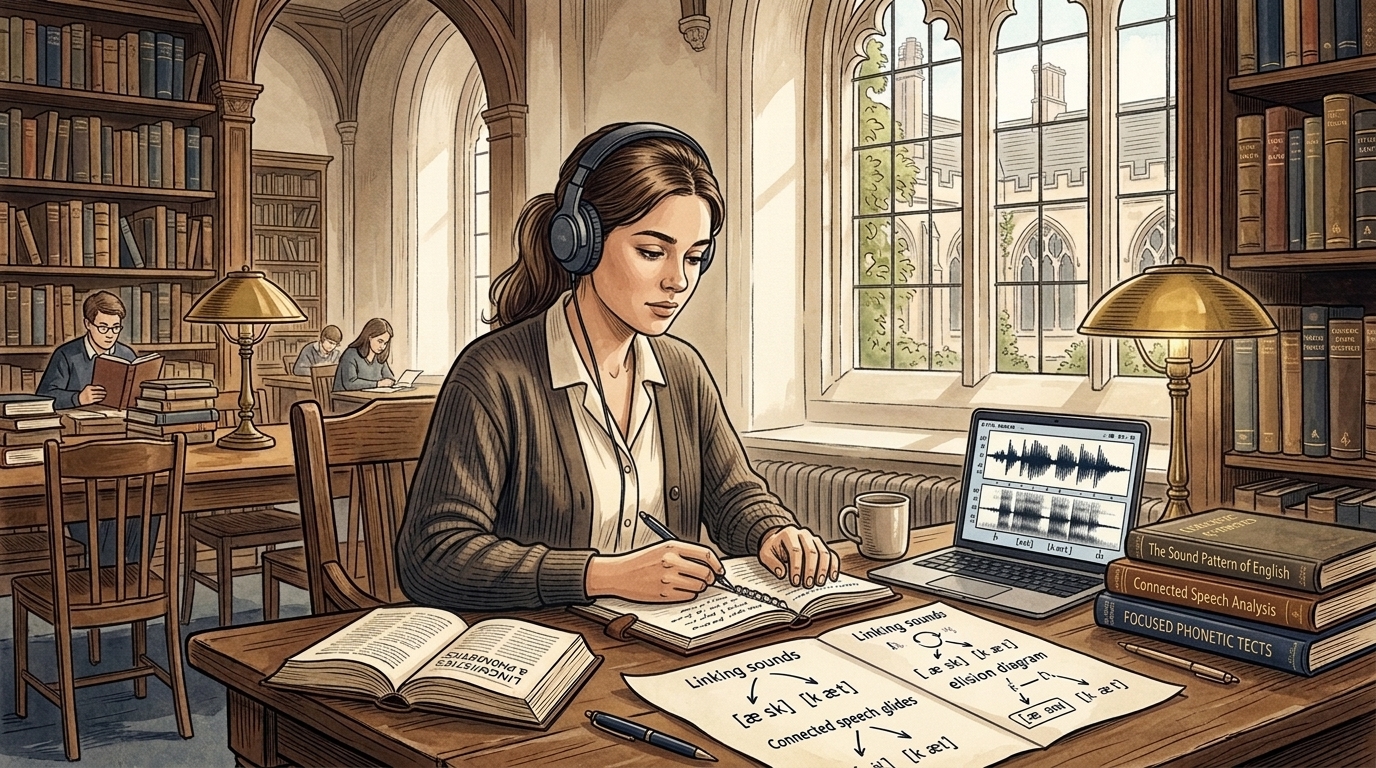
If you have ever listened to a native English speaker, understood every word, but found yourself speaking in a rigid, halting manner when it was your turn to talk, you are experiencing a breakdown between auditory comprehension and articulatory motor execution.
Traditional language study focuses on silent reading and grammatical rules. However, spoken language is fundamentally a motor skill—much like playing the violin or executing a tennis serve.
The single most proven, neuroscientifically validated method for developing native-like prosody, sentence stress, and speech speed is the Speech Shadowing Technique (pioneered by linguist Prof. Alexander Arguelles).
Here is the complete step-by-step blueprint to implement speech shadowing into your daily routine.
1. What Exactly Is Speech Shadowing?
Shadowing is an advanced linguistic training technique where you listen to authentic spoken audio and repeat what you hear simultaneously with a fractional delay of only 0.2 to 0.5 seconds (like an acoustic shadow).
Unlike traditional "listen and repeat" drills (where you wait for the speaker to finish the entire sentence before repeating), shadowing forces your brain to:
- Process incoming phonemes and intonation curves in real-time.
- Mirror native speech melody, breathing pauses, and rhythm without cognitive translation delay.
- Automatically adopt connected speech features (linking, elision, weak forms).
2. The 5-Stage Progressive Shadowing Protocol
To get maximum acoustic benefit without feeling overwhelmed, follow this 5-stage progressive framework:
Stage 1: Blind Listening & Auditory Mapping (No Text)
- Listen to a 60–90 second native audio clip 2–3 times with your eyes closed.
- Focus exclusively on the musical contours: Where does the pitch rise and fall? Where are the rhythmic beats? Where does the speaker take a breath?
Stage 2: Script Analysis & Phonetic Marking
- Open the written transcript.
- Use a highlighter to mark:
- Stressed Content Words (circle them).
- Weak Forms / Schwas (mark with /ə/).
- Thought Group Boundaries (draw a slash
/for pauses). - Linking Points (draw an arc between connected words).
Stage 3: Reading Aloud with Script (Dry Run)
- Read the transcript out loud at a steady pace, deliberately exaggerating the stress and linking marks you made in Stage 2.
Stage 4: Active Shadowing with Script (Eyes on Text)
- Play the audio through headphones.
- Speak out loud simultaneously with the speaker, lagging roughly half a second behind.
- Match their exact pitch peaks, vowels, and volume dynamics.
Stage 5: Blind Shadowing (No Text, Head Up)
- Put the transcript away. Stand up or walk around the room.
- Shadow the speaker purely by ear. This forces complete reliance on your auditory cortex and motor reflexes.
3. Selecting the Ideal Shadowing Material
The quality of your results depends entirely on choosing the right source material:
| Parameter | Recommended Standard | Why It Matters |
|---|---|---|
| Audio Length | 60 to 120 seconds | Short clips allow 10–15 high-density repetitions per session. |
| Speaker Accent | Target dialect (GenAm, RP, AusE) | Consistency prevents dialectal contamination during motor training. |
| Speaking Speed | Natural conversational tempo (140–160 wpm) | Avoids artificial classroom cadence. |
| Audio Quality | High-fidelity studio audio (podcasts, audiobooks, TED Talks) | Clear high-frequency response ensures sibilants (/s, z, θ/) are audible. |
4. The 20-Minute Daily Shadowing Habit
Consistency beats marathon sessions. Stick to this 20-minute daily schedule:
- Minutes 0–3: Blind listen to yesterday's clip once, then listen to today's new clip twice.
- Minutes 3–7: Mark up the transcript (stress, linking, pauses).
- Minutes 7–15: Perform 5–8 active shadowing repetitions with headphones.
- Minutes 15–18: Record your own solo reading of the passage on your phone.
- Minutes 18–20: Benchmark your audio recording on Accent Test to monitor your progress!
5. Common Shadowing Pitfalls to Avoid
- Mumbling in Your Throat: Shadowing must be performed with full vocal projection. Whispering does not activate the oral motor muscles required for speech clarity.
- Stopping When You Make a Mistake: If you stumble over a word, do NOT pause the audio. Keep going with the flow and catch the next phrase.
- Choosing Material That Is Too Advanced: If the vocabulary is beyond your comprehension level, your cognitive load will be consumed by semantic decoding rather than phonetics.
Ready to Test Your Shadowing Gains?
Take our free interactive Accent Test before and after a 14-day shadowing streak to hear noticeable improvements in your acoustic intelligibility and speech rhythm!
The Accent Test editorial team creates evidence-based guides on English phonetics, pronunciation, and intelligibility, referencing the International Phonetic Alphabet (IPA), CEFR benchmarks, and applied phonology research.
Ready to Benchmark Your English Accent?
Record a short audio sample to get an instant acoustic analysis of your vowel formants, rhythm stress-timing, and clarity score.
Take the Accent Test