American vs. British Accent: Key Differences, Phonetics, and How to Master Both
A comprehensive phonetic comparison of General American and British RP. Learn about rhoticity, T-flapping, Yod-dropping, vowel shifts, and word stress patterns.
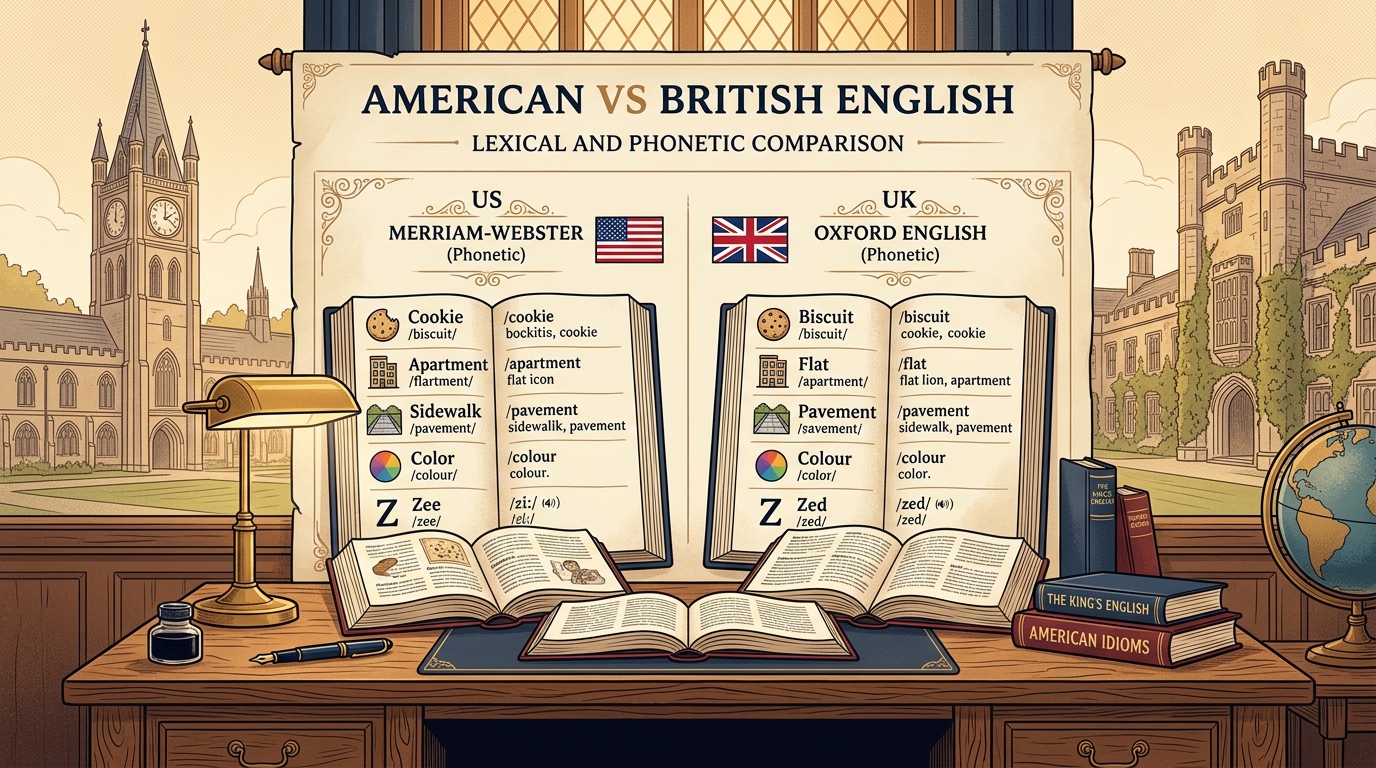
When English learners establish an accent goal, the two most influential reference standards are General American (GenAm) and British Received Pronunciation (RP) (also referred to as BBC English or Standard Southern British).
While both dialects are universally understood across international business, academia, and aviation, they exhibit distinct acoustic rules, vowel trajectories, consonant behaviors, and stress placement.
In this guide, we break down the 6 defining phonetic pillars that separate American and British pronunciation, accompanied by an extensive comparison table and practical training drills.
1. Rhoticity: The "R" Sound (The Master Divider)
The single most consequential divider between American and British speech is rhoticity:
- American English (Rhotic): The letter r is articulated wherever it appears in spelling (car, water, hard, butter, bird, first). The tongue curls back into the retroflex position or bunches upward against the molars to generate strong R-coloring (low third formant ).
- British English (Non-rhotic): The consonant /r/ is silent unless it is immediately followed by a vowel sound in the same or next word. Words like car /kɑː/ and water /ˈwɔːtə/ end in open vowel sounds instead.
Acoustic Rule:
- American: “Park the car in Harvard Yard” → /pɑːrk ðə kɑːr ɪn ˈhɑːrvərd jɑːrd/
- British: “Park the car in Harvard Yard” → /pɑːk ðə kɑː ɪn ˈhɑːvəd jɑːd/
2. The Flap "T" vs. Crisp Aspirated "T"
How you articulate the letter T between vowel sounds reveals your accent dialect instantly:
- American English (T-Flapping): When /t/ occurs between two vowels and before an unstressed syllable, it transforms into a voiced alveolar tap [ɾ] (sounding like a rapid, soft /d/). For instance, water sounds like "wah-der", and city sounds like "si-dee".
- British English (Aspirated /t/ or Glottal Stop [ʔ]): In formal RP, the /t/ remains crisp and aspirated with an audible release of air. In contemporary casual British dialects (such as Estuary English), /t/ before consonants or word endings is frequently replaced by a glottal stop [ʔ] (bottle → bo'el).
3. Vowel Shifts: Trap-Bath Split and Short "O"
Vowels carry the distinctive melody of each dialect. Four fundamental shifts define the US vs. UK vowel landscape:
1. The Trap-Bath Split (Broad A)
In British RP, words historically containing /æ/ before voiceless fricatives (-s, -f, -th) or nasal clusters (-nt, -nd, -mp) shifted to the long back vowel /ɑː/ (broad A). General American retained the original short front vowel /æ/:
- dance: US /dæns/ vs. UK /dɑːns/
- bath: US /bæθ/ vs. UK /bɑːθ/
- fast: US /fæst/ vs. UK /fɑːst/
- half: US /hæf/ vs. UK /hɑːf/
2. The LOT-CLOTH Split (Unrounded Short O)
In American English, the short "o" vowel in hot, spot, coffee, lock is unrounded into an open back vowel /ɑː/ (rhyming with father). In British English, it remains a rounded, short open back vowel /ɒ/:
- hot: US /hɑːt/ vs. UK /hɒt/
- coffee: US /ˈkɑːfi/ or /ˈkɔːfi/ vs. UK /ˈkɒfi/
3. The GOAT Vowel Glide
In American English, the vowel in go, home, road starts back with rounded lips /oʊ/. In British English, it begins with a central, neutral schwa before gliding forward: /əʊ/.
4. Yod-Dropping (The Vanishing /j/ Sound)
In British English, the palatal approximant /j/ (the "y" sound) is preserved after alveolar consonants (/t, d, n, s, z, l/). In American English, this /j/ is systematically dropped (Yod-Dropping):
| Word | General American (Yod-Dropped) | British RP (Yod-Preserved) |
|---|---|---|
| tune | /tuːn/ ("toon") | /tjuːn/ ("tyoon") |
| news | /nuːz/ ("nooz") | /njuːz/ ("nyooz") |
| duke | /duːk/ ("dook") | /djuːk/ ("dyook") |
| duty | /ˈduːti/ | /ˈdjuːti/ |
| suit | /suːt/ | /sjuːt/ or /suːt/ |
| new | /nuː/ | /njuː/ |
5. Syllable Stress Differences in Everyday Vocabulary
Interestingly, American and British English place the primary lexical stress on completely different syllables in dozens of common French-derived or compound words:
| Word | General American Stress | British English Stress |
|---|---|---|
| garage | ga-RAGE /ɡəˈrɑːʒ/ (2nd syllable) | GAR-age /ˈɡærɑːʒ/ or /ˈɡærɪdʒ/ (1st syllable) |
| ballet | bal-LET /bæˈleɪ/ (2nd syllable) | BAL-let /ˈbæleɪ/ (1st syllable) |
| address | AD-dress /ˈædres/ (1st syllable) | ad-DRESS /əˈdres/ (2nd syllable) |
| adult | a-DULT /əˈdʌlt/ (2nd syllable) | AD-ult /ˈædʌlt/ (1st syllable) |
| debris | de-BRIS /dəˈbriː/ (2nd syllable) | DEB-ris /ˈdebriː/ (1st syllable) |
| vaccine | vac-CINE /vækˈsiːn/ (2nd syllable) | VAC-cine /ˈvæksiːn/ (1st syllable) |
| buffet | buf-FET /bəˈfeɪ/ (2nd syllable) | BUF-fet /ˈbʊfeɪ/ (1st syllable) |
6. Comprehensive 20-Word US vs. UK Phonetic Table
| Word | General American (IPA) | British English RP (IPA) | Primary Phonetic Difference |
|---|---|---|---|
| water | /ˈwɑːtər/ or /ˈwɔːtər/ | /ˈwɔːtə/ | Rhoticity + T-flapping vs. Non-rhotic |
| better | /ˈbetər/ | /ˈbetə/ | Flapped [ɾ] vs. Crisp aspirated [t] |
| schedule | /ˈskedʒuːl/ | /ˈʃedʒuːl/ | Initial /sk/ vs. /ʃ/ ("sked" vs "shed") |
| tomato | /təˈmeɪtoʊ/ | /təˈmɑːtəʊ/ | Vowel /eɪ/ vs. /ɑː/ ("may" vs "mah") |
| herb | /ɜːrb/ (Silent H) | /hɜːb/ (Aspirated H) | Silent 'h' vs. Pronounced 'h' |
| vitamin | /ˈvaɪtəmɪn/ | /ˈvɪtəmɪn/ | First vowel: /aɪ/ vs. /ɪ/ |
| neither | /ˈniːðər/ or /ˈnaɪðər/ | /ˈnaɪðə/ | Vowel preference: /iː/ vs /aɪ/ |
| route | /raʊt/ or /ruːt/ | /ruːt/ | Dual diphthong variant in US |
| privacy | /ˈpraɪvəsi/ | /ˈprɪvəsi/ | First vowel: /aɪ/ vs. /ɪ/ |
| leisure | /ˈliːʒər/ | /ˈleʒə/ | First vowel: /iː/ vs. /e/ |
| advertisement | /ˌædvərˈtaɪzmənt/ | /ədˈvɜːtɪsmənt/ | Stress on 3rd vs. 2nd syllable |
| laboratory | /ˈlæbrətɔːri/ | /ləˈbɒrətri/ | 4 syllables (US) vs. 4 compressed (UK) |
| semi | /ˈsemaɪ/ or /ˈsemi/ | /ˈsemi/ | Diphthong /aɪ/ ending in US |
| mobile | /ˈmoʊbəl/ or /ˈmoʊbiːl/ | /ˈməʊbaɪl/ | Weak schwa vs. /aɪ/ diphthong |
| vase | /veɪs/ or /veɪz/ | /vɑːz/ | Vowel /eɪ/ vs. /ɑː/ |
| aluminum | /əˈluːmɪnəm/ | /ˌæljəˈmɪniəm/ | Different spelling and extra syllable |
| clerk | /klɜːrk/ | /klɑːk/ | /ɜːr/ vs. /ɑː/ |
| lieutenant | /luːˈtenənt/ | /lefˈtenənt/ | /luː-/ vs. /lef-/ |
| glacier | /ˈɡleɪʃər/ | /ˈɡlæsiə/ | /eɪ/ vs. /æ/ |
| either | /ˈiːðər/ or /ˈaɪðər/ | /ˈaɪðə/ | Common /iː/ choice in US |
7. Which Accent Should You Choose?
As an ESL learner, should you target American or British English?
- Choose American English if: You collaborate primarily with North American tech companies, watch Hollywood media, or prefer the fluid rhythm of T-flapping and rhotic consonants.
- Choose British English if: You are preparing for UK / European academic institutions, work in Commonwealth markets (UK, Australia, South Africa), or prefer the distinct melodic cadence of non-rhotic speech.
- The Core Golden Rule: Consistency is key. Avoid mixing strong British vowels with aggressive American rhotic R's in the same sentence.
Benchmark Your US vs. UK Accent Profile
Curious which traits dominate your current speaking voice? Take our free Accent Test—record our diagnostic passage and receive an instant breakdown of your American vs. British phonetic characteristics!
The Accent Test editorial team creates evidence-based guides on English phonetics, pronunciation, and intelligibility, referencing the International Phonetic Alphabet (IPA), CEFR benchmarks, and applied phonology research.
Ready to Benchmark Your English Accent?
Record a short audio sample to get an instant acoustic analysis of your vowel formants, rhythm stress-timing, and clarity score.
Take the Accent Test